Most couples agree on the importance of saving. They talk about future plans, major purchases, travel ideas, emergency funds, and long-term stability. Yet even when savings accounts exist, motivation often fades because progress feels invisible.
Money leaves a checking account and enters a savings account, but nothing about that transfer feels tangible. Months pass. Balances increase slowly. The goal remains abstract.
When progress is abstract, enthusiasm declines. When enthusiasm declines, spending becomes easier to justify and saving feels optional. A shared savings goal board solves this problem by making progress visible.
It turns invisible numbers into something you can see, track, and revisit regularly. It creates accountability without pressure. It transforms saving from a quiet obligation into a shared project.
This system is simple to implement, adaptable to any income level, and powerful over time because it changes how couples experience progress.
Why Saving Often Loses Momentum
Saving money requires delayed gratification. The reward is not immediate. You do not feel it daily the way you feel a purchase.
When savings live exclusively in a banking app, they are technically visible but emotionally distant. You might glance at a balance occasionally, but you do not see progress incrementally.
Couples may also struggle with different priorities. One partner might feel excited about saving for travel. The other may care more about home improvements or financial security.
Without a shared visual anchor, goals compete silently. A visible savings board aligns direction.
What a Shared Savings Goal Board Actually Is
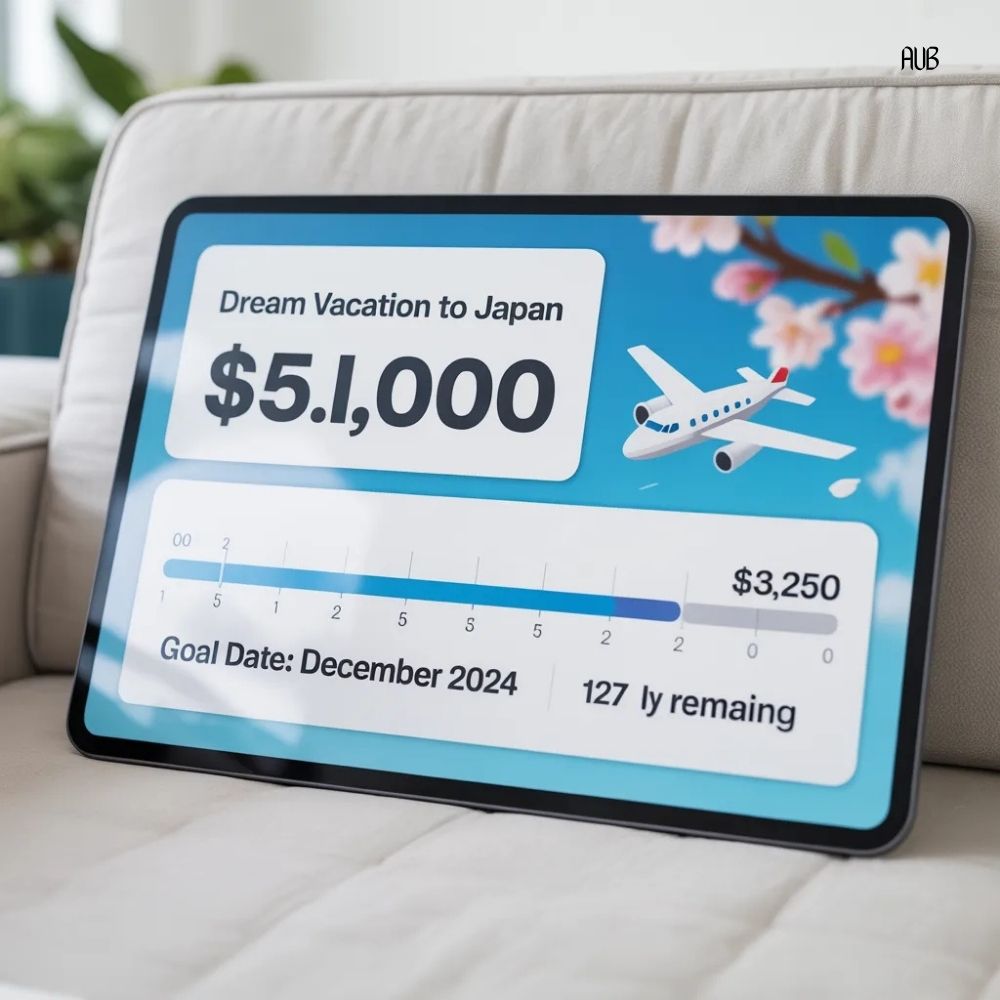
A savings goal board is a physical or digital visual representation of a specific financial target and the progress made toward it. It includes:
- A clearly defined goal
- A specific target amount
- A visible progress tracker
- A realistic timeline
The board can be as simple as a printed chart in a frame or as detailed as a custom-designed progress thermometer mounted in a home office. The key is that it is shared and visible.
It should live in a place you see regularly, such as near a desk, inside a closet door, or on a bulletin board. Visibility creates awareness. Awareness strengthens discipline.

Step 1: Choose One Primary Goal
Many couples attempt to save for multiple goals simultaneously. While that is practical, it can dilute focus. Start by choosing one primary shared savings goal. Examples might include:
- A vacation fund
- A home down payment
- A renovation project
- An emergency fund milestone
- A new car
Selecting one goal does not eliminate others. It simply creates a visible focal point. Clarity increases commitment.
During your initial discussion, define the goal in measurable terms. Instead of saying, “We want to save for travel,” decide, “We want to save $5,000 for a trip next summer.” Specificity matters.
Step 2: Set a Timeline That Feels Achievable
An undefined timeline weakens motivation. When a goal has no endpoint, urgency fades. Agree on a realistic timeline. Calculate how much needs to be saved monthly or biweekly to reach the target.
For example, if your goal is $5,000 in ten months, you need to save $500 per month. This clarity transforms the goal from abstract hope into actionable steps. The board should reflect both the final amount and the monthly contribution target.
Step 3: Create a Visual Tracker
The visual tracker is the heart of the system. You can design:
- A progress bar that fills incrementally
- A thermometer-style chart
- A grid where each square represents a set dollar amount
- A circular chart that fills like a pie
Choose a format that feels satisfying to update. Each time you transfer money into the savings account, update the board immediately.
Coloring in a segment, shading a box, or moving a marker creates psychological reward. It reinforces progress visually rather than numerically. This physical interaction strengthens motivation.
Step 4: Pair Transfers With Visible Updates
The board only works if it stays current. Whenever a savings transfer occurs, update the board within 24 hours. This habit connects action to reward.
For example, after transferring $500 into savings, shade in the corresponding section on the board. The visual reinforcement builds momentum.
Couples often find that once the board reaches halfway, motivation increases because the finish line feels closer. Visible progress changes perception.
Step 5: Review Progress Monthly Together
Set aside a few minutes at the end of each month to review the board. Confirm:
- How much progress was made
- Whether contributions stayed on track
- If adjustments are needed
This conversation should remain calm and factual.
If contributions were lower one month, discuss whether it was temporary or whether the timeline needs revision. The board makes these conversations objective rather than emotional. Progress reviews strengthen partnership because both people see the same information.
Avoiding Common Mistakes
Some couples create overly complicated boards with multiple simultaneous goals, color codes, and financial categories. Complexity often leads to abandonment. Keep the first board simple.
Another mistake is placing the board somewhere hidden. If it lives inside a drawer, it loses power. Visibility fuels consistency.
Finally, avoid using the board to apply pressure. If one month falls short, treat it as data, not failure. The board is a tool for clarity, not criticism.
The Psychological Advantage of Visibility
Behavioral research consistently shows that visible tracking increases follow-through. When progress is abstract, it feels distant. When progress is visible, it feels achievable. A shared savings goal board does three important things:
- It aligns partners around one direction
- It transforms numbers into visible progress
- It creates small moments of celebration along the way
Each shaded segment represents cooperation. Over time, that cooperation strengthens trust.
Expanding the System Over Time
Once your first goal is achieved, consider maintaining the board structure for future milestones. You might rotate goals annually or create a smaller secondary tracker for emergency funds while keeping the primary board for larger milestones.
As your financial stability grows, the board can evolve to reflect more ambitious goals. The habit of visual tracking becomes part of your household rhythm.
The Long-Term Impact
Financial stability is built gradually. Without visible reinforcement, it can feel slow and unremarkable. A shared savings goal board changes that experience.
Over time, this visual system strengthens alignment and reinforces the idea that you are building something together.
And when progress is visible, motivation becomes easier to sustain. The board does not just track savings. It documents partnership in action.